
2,500 years ago, Hippocrates wrote: “Give me the power to create a fever, and I will cure any disease.” The father of medicine had already understood what science is rediscovering today: the deliberate alternation of hot and cold is not a form of torture, but a remedy.
From ancient Greece to Finnish saunas, Russian banyas to Japanese onsens, almost every great civilization has developed its own version of the hot-cold ritual. What we call contrast therapy today is actually a millennia-old practice whose precise physiological mechanisms have only begun to be understood in recent decades.
What is contrast therapy?
Contrast therapy involves the voluntary and rapid alternation between heat exposure (15 to 20 minutes in a 70–90°C sauna) and cold exposure (1 to 3 minutes in 2–15°C water). Repeated two to four times in a single session, this alternation triggers a unique physiological cascade.
It is not a new practice. What is new is our scientific understanding of the mechanisms at play—and especially our ability to practice it at home without building a wooden sauna or installing a professional pool.
A millennia-old ritual, rediscovered
Almost every civilization that had access to both heat and cold water developed a form of contrast therapy.
In ancient Greece, gymnasia included both heated rooms and cold-water pools. The Romans perfected the ritual with their three-part baths: caldarium, tepidarium, frigidarium.
In Finland, the traditional sauna has been practiced for over 2,000 years, almost always followed by a dip in a frozen lake. Finland now has 3 million saunas for 5.5 million inhabitants.
In Russia, the banya alternates steam sauna and cold-water pools. In Japan, onsens incorporate pools of different temperatures into a ritual that is as much spiritual as physical.
What all these cultures sensed—without the language of modern science—is that the human body needs controlled thermal stress to function properly. Our era of constant comfort has cut us off from this oscillation. Contrast therapy restores it.
What happens in your body
During the sauna, your body temperature rises by 1 to 2°C. Blood vessels dilate, and your heart rate increases as if you were exercising moderately. Your body releases heat shock proteins (HSPs), which help repair damaged cells.
Then comes the cold. In a few seconds, everything reverses. The vessels contract sharply, your sympathetic nervous system activates at 100%, releasing massive amounts of noradrenaline and dopamine.
Then you return to the heat, and the vascular movement reverses again. It is this back-and-forth—this “vascular gymnastics”—that produces most of the benefits. Your vessels, hormones, and nervous system undergo a real workout.
The benefits measured by science
Nervous system regulation
Contrast therapy strengthens vagal flexibility—your nervous system's ability to switch quickly from a state of activation to a state of calm. A recognized marker of good mental and physical health.
Deep, restorative sleep
The combined effect of heat (muscle relaxation) and cold (post-immersion body cooling) creates the ideal conditions for falling asleep quickly and enjoying quality deep sleep.
Cardiovascular longevity
A major study by the University of Jyväskylä in Finland, involving over 2,300 men followed for 20 years, showed that regular sauna use (4 to 7 times a week) was associated with a 40% reduction in the risk of cardiovascular mortality.
Muscle recovery
For athletes, contrast therapy reduces post-exercise inflammation, improves recovery between sessions, and decreases muscle soreness.
A measurable impact on mood
The massive release of dopamine and noradrenaline during the cold phase, combined with the relaxing effect of the sauna, produces a unique emotional state—often described as “a complete mental reset.”
The classic protocol
- Step 1 — Sauna, 15 to 20 minutes at 70–90°C
- Step 2 — 1-minute break to wipe off sweat
- Step 3 — Cold bath, 2 to 3 minutes at 5–12°C
- Step 4 — 3 to 5-minute break at room temperature
- Step 5 — Repeat the cycle 2 to 4 times
Golden rule: always finish with the cold. Finishing with heat leaves you vasodilated and tired. Finishing with cold leaves you in a stable state of energy and clarity.
At home or at a spa?
Practicing at a spa costs €30 to €80 per session, requires adhering to set times, and makes it difficult to maintain the consistency that produces real benefits.
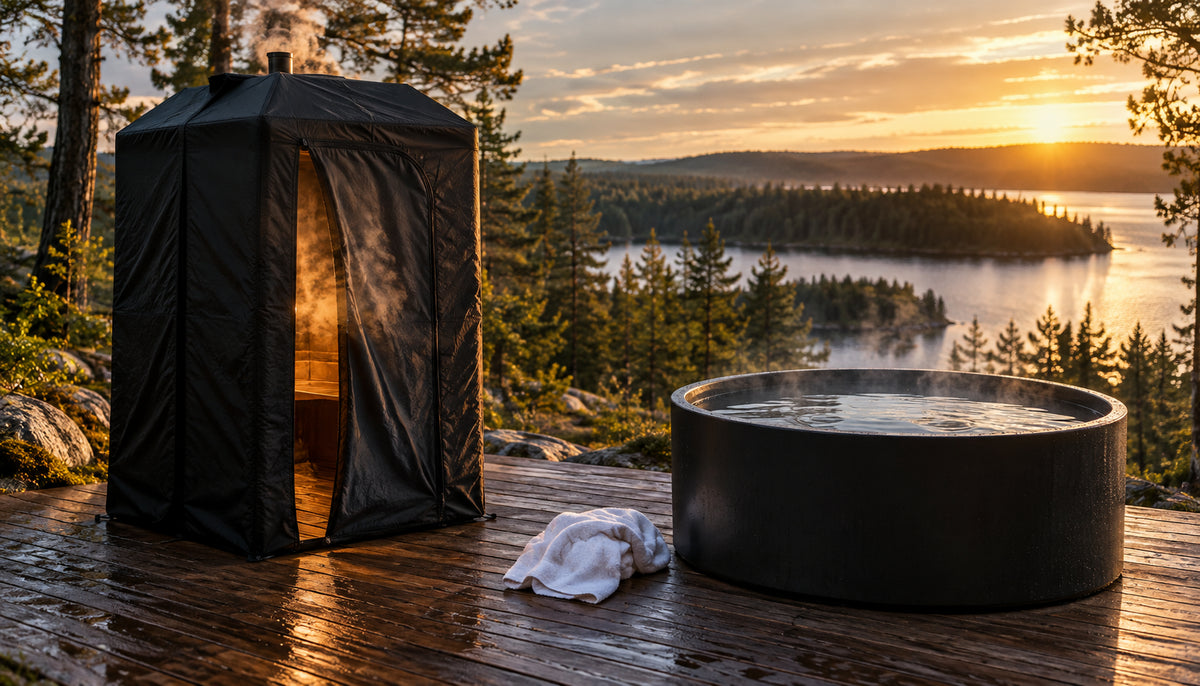
This is why home practice has grown massively. At Icepiration, we have designed portable baths that can be set up in 10 minutes and a portable Finnish sauna that plugs into a standard 220V outlet. Together, they allow you to recreate the complete ritual at home—without any construction.
👉 Build your contrast therapy setup in 3 steps with our configurator.
Frequently asked questions
How long should I wait between the heat and the cold?
Ideally, you should go directly from one to the other, or with a transition of 30 seconds to 1 minute at most. It is the sharp contrast that produces most of the effects.
Can you do contrast therapy every day?
Yes, as long as you are acclimated (after 6 weeks of regular practice).
Is a sauna mandatory?
No. You can start with a hot bath (40–42°C) followed by a cold bath. The effect will be slightly less, but real.
Are there any risks?
Contraindicated in cases of uncontrolled heart problems, severe hypertension, pregnancy, or epilepsy. Consult your doctor if in doubt.
Conclusion
Contrast therapy is not a passing trend. It is a millennia-old practice, validated by modern science, whose effects on the body and mind are profound and lasting.
👉 Build your setup in 3 steps with our online configurator.
Sources: Laukkanen et al., JAMA Internal Medicine, 2015; Šrámek et al., European Journal of Applied Physiology, 2000; Kox et al., PNAS, 2014.
Cold bath: benefits, protocol and complete guide to get started
Cold-induced muscle recovery: what does science really say?