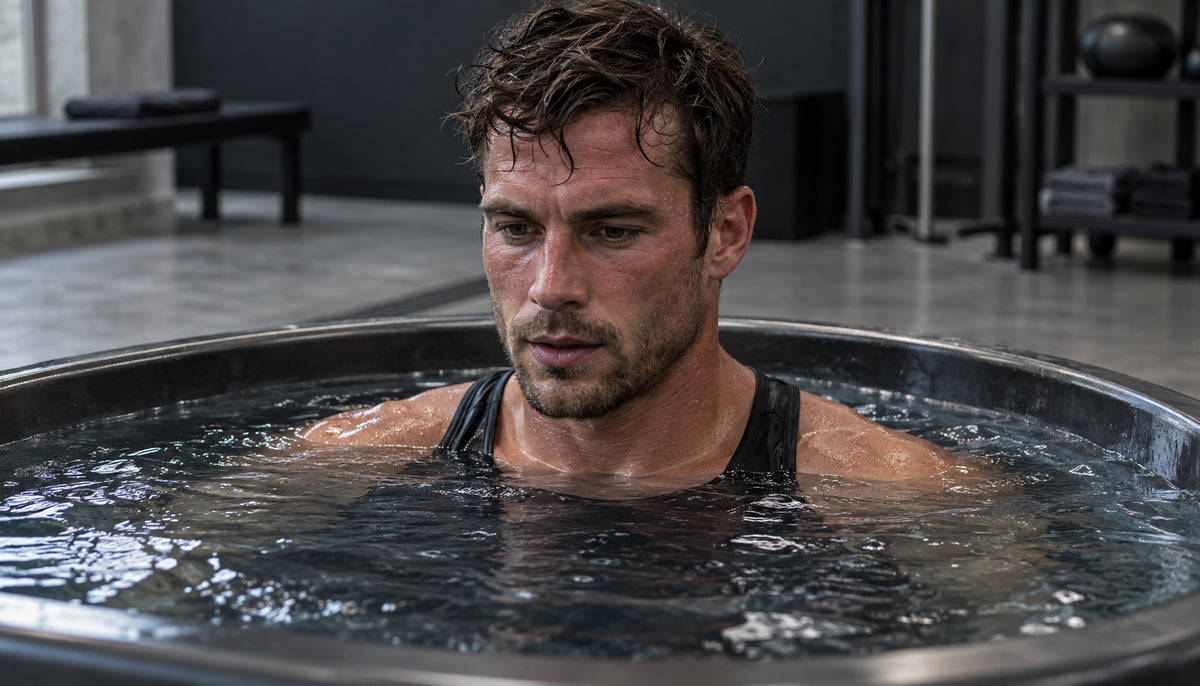
Since the 2010s, elite athletes have been taking ice baths after training. Rugby players, footballers, runners, CrossFit athletes: the ritual has become widespread. But the real question, one that few athletes ask themselves: does it actually work? And above all, under what conditions?
This guide sorts through what is scientifically proven, what remains debated, and the mistakes to avoid. Objective: to give you a validated protocol, tailored to your discipline.
What is muscle recovery?
After intense exercise, your muscles suffer micro-injuries. These injuries trigger an inflammatory response — swelling, pain, stiffness — which is part of the repair process. This inflammation is both a repair signal (it attracts the cells that rebuild) and a source of discomfort (soreness, loss of mobility).
Muscle recovery is the set of mechanisms that allow your muscles to return to their optimal state — or even stronger than before. We are talking about supercompensation. The challenge: accelerate repair without harming long-term adaptations.
How cold affects the muscles
Cold water immersion triggers several immediate physiological mechanisms:
- Vasoconstriction: the blood vessels in the muscles contract, reducing blood flow and thus local inflammation
- Reduction in cellular metabolism: the cold slows down the enzymatic processes related to muscle breakdown
- Analgesic effect: the cold numbs the nerve endings, reducing the perception of pain
- Post-immersion vasodilation: upon exiting the bath, the vessels dilate abruptly, causing a beneficial blood flow to the muscles
It is this combination that explains the sensation of "new legs" felt a few hours after a cold bath.
What scientific studies really say
Solid evidence
A Cochrane meta-analysis (Bleakley et al., 2012) covering 17 studies showed that cold water immersion significantly reduces delayed onset muscle soreness (DOMS) 24 to 96 hours after exercise. The effect is particularly marked in endurance sports.
A study by Leeder et al. (2012) confirmed that the cold bath improves the subjective perception of recovery and allows athletes to resume training earlier without overload.
Important nuances
This is where it gets interesting. A major study by Roberts et al. (2015) published in The Journal of Physiology showed that systematic cold baths after strength training reduce long-term gains in hypertrophy and strength. Why? Because post-exercise inflammation is an essential signal for muscle adaptation. Systematically eliminating it means slowing down your progress.
This study turned practices upside down in the world of strength and bodybuilding. It does not invalidate the cold bath — it specifies its use.
The key nuance: cold bath according to your discipline
Endurance sports (running, cycling, swimming)
The cold bath is very effective. Do it immediately after exercise or within the 2 hours that follow. It reduces inflammation, accelerates recovery, and allows you to chain workouts without overload. No documented negative impact on endurance adaptations.
Strength sports (bodybuilding, powerlifting)
To be used sparingly. Avoid the cold bath in the 4 to 6 hours following a strength session. If you want to benefit from the neurohormonal benefits of cold, do it on rest days or in the morning away from the session.
Mixed sports (CrossFit, team sports, martial arts)
The cold bath after training is beneficial for overall recovery, even if it may slightly attenuate pure strength gains. The trade-off leans in favor of the cold bath for the majority of practitioners seeking versatile performance.
Competition sports (match or tournament period)
The cold bath is systematically recommended between two close events. Priority to short-term recovery, even if it means sacrificing a little long-term adaptation.
The optimal cold recovery protocol
- Water temperature: between 10 and 15°C for recovery (colder does not bring anything more)
- Duration: 10 to 15 minutes for maximum recovery effect (unlike the cold bath for stress, which is done in 2-3 min)
- Timing: immediately after exercise for endurance, or 4-6h after for strength sports
- Frequency: after the most intense sessions or during competition periods
Pro tip: for endurance sports, a cold bath 20 minutes after exercise gives the best measured results. Some studies show a 15% improvement in performance during the next session 24h later.
The crucial timing: the anabolic window
After intense exercise, your body opens an "anabolic window" for about 2 hours, during which protein synthesis is at its maximum. The cold bath during this period accelerates recovery but can attenuate certain adaptation signals.
Our recommendation: respect at least 30 minutes between the end of exercise and the cold bath. This gives the first hormonal signals (hematocrit, testosterone, growth hormone) time to establish themselves before the cold partially blocks inflammation.
Equipment: what cold bath for recovery?
For regular sports use, you need a cold bath capable of maintaining a stable temperature between 10 and 15°C, with enough space to immerse up to the shoulders.
Our portable Icepiration baths are used by many CrossFit boxes and sports clubs, with or without a chiller depending on the climate and frequency of use. For an individual athlete who practices 3 times a week, a portable bath with ice is more than enough. For daily use or several people, a chiller quickly becomes indispensable.
👉 Compose your recovery setup with our configurator.
Frequently asked questions
Cold bath or cold shower after sports?
For recovery, full immersion is clearly superior. The cold shower touches 20-30% of the body surface; the cold bath, 90%. The effects are not comparable.
How many times a week?
After the 2 to 3 most intense sessions of the week. Not systematically after every training.
Can I take a cold bath after a competition?
Yes, it is even one of the best times. Do it within the hour following the end of the event.
Should it be combined with compression or massage?
Yes. A combination of cold bath + self-massage (roller, massage gun) + electrostimulation is the most complete approach. The cold bath reduces inflammation, the massage works mechanical tensions.
Conclusion: your protocol according to your sport
The cold bath is not a universal recovery tool. It is a powerful but contextual tool. Used intelligently — at the right time, at the right temperature, adapted to your discipline — it makes a real difference on your recovery and your performance. Used systematically after every bodybuilding session, it can slow down your progress.
Our recommendation: start by integrating the cold bath after your 2 biggest endurance sessions of the week. Observe the effects for one month. Then adjust.
👉 Discover our pro range for athletes and clubs.
Sources: Bleakley et al., Cochrane, 2012; Roberts et al., Journal of Physiology, 2015; Leeder et al., British Journal of Sports Medicine, 2012.
Contrast therapy: the complete hot-cold guide (sauna + ice bath)
How long should you stay in a cold bath? The guide according to your level