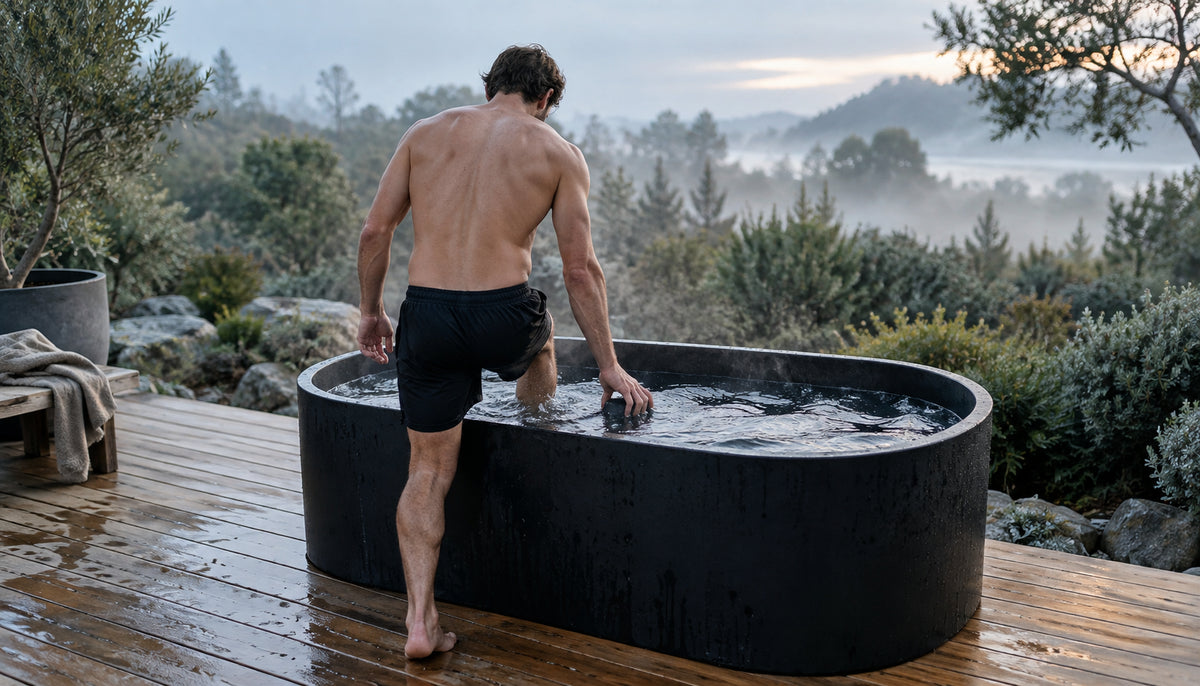
In recent years, a practice from the North has revolutionized our approach to well-being: the cold bath. Elite athletes, entrepreneurs, overworked executives, wellness enthusiasts — more and more people are spending three minutes a day in water at less than 12°C. Not out of masochism. Because the measurable effects last long after getting out of the bath.
This guide covers the entire topic: what science really says, how cold affects the body, what protocol to follow to get started, and how to integrate this practice into your daily life — at home, without complicated equipment.
What is a cold bath?
A cold bath — or cold plunge in English — refers to the voluntary immersion of the body in water maintained between 2 and 15°C, for a short duration (generally 2 to 5 minutes). This practice is part of a broader family called cold therapy, which also includes cold showers, whole-body cryotherapy, and Nordic swimming.
Contrary to popular belief, the cold bath is not a recent invention: the ancient Greeks, Romans, and Scandinavian peoples used it for centuries to restore energy and strengthen the body. What has changed today is that modern science confirms — and explains — these ancestral benefits.
The 6 scientifically validated benefits of cold baths
1. A better-regulated nervous system
This is the most immediate and well-documented effect. Cold exposure abruptly activates the vagus nerve, the main conductor of your parasympathetic nervous system. As a result, after a few weeks of regular practice, your ability to manage stress improves measurably. This is called vagal flexibility, and it is a recognized marker of psychological well-being.
2. A neurotransmitter explosion
A landmark study conducted at Charles University in Prague (Šrámek et al., 2000) measured a +530% increase in noradrenaline and a +250% increase in dopamine after a few minutes of immersion in cold water. This hormonal surge is responsible for the state of mental clarity and energy felt one to three hours after the bath — a natural effect comparable to that of a strong coffee, but without the cortisol spike.
3. Deeper sleep
The cold bath lowers the body's core temperature, which makes falling asleep easier (the drop in body temperature is a natural sleep signal). Several studies (notably Harding et al., Sleep Medicine Reviews, 2019) show an improvement in deep sleep quality among regular practitioners. A cold bath in the late afternoon or early evening can be particularly beneficial for mild insomnia.
4. Accelerated muscle recovery
This is the best-known benefit in the sports world. Cold water immersion reduces post-exercise muscle inflammation, decreases muscle soreness, and accelerates recovery between two sessions. However, beware: for strength or hypertrophy training, it is better to wait 4 to 6 hours after the session so as not to impair muscle adaptation.
5. A strengthened immune system
A Dutch study involving more than 3,000 adults (Buijze et al., 2016) showed that people taking a daily cold shower had 29% fewer sick days over one year. Regular cold stimulation seems to activate certain innate immune mechanisms.
6. A more stable mood
The dopamine released during immersion remains elevated for several hours after the bath. In regular practitioners, this repeated exposure to a controlled stressful stimulus seems to improve overall mood and reduce mild anxiety symptoms. The cold bath is not a medical treatment, but a powerful daily regulation tool.
How cold affects the body: clear physiology
When you enter water at 5°C, your body triggers a cascade of responses in a few seconds:
- Peripheral vasoconstriction — the blood vessels in the skin contract to conserve heat around the vital organs.
- Noradrenaline release — the sympathetic nervous system activates to prepare the body to "survive" this controlled aggression.
- Thermogenic shivering — the muscles produce heat through rapid contraction.
- Activation of brown fat — special adipose tissue starts burning calories to produce heat.
It is this cascade, repeated regularly, that produces beneficial long-term adaptations. The human body is designed to be exposed to cold — the era of central heating simply made us forget it.
The ideal protocol to get started
Here is the protocol we recommend to our clients who are discovering the practice. It is progressive, safe, and effective.
Weeks 1 to 2: discovery
- Water temperature: between 12 and 15°C
- Immersion duration: 1 to 2 minutes
- Frequency: 2 to 3 times a week
- Objective: tame the sensation, learn to breathe calmly
Weeks 3 to 6: establishment
- Temperature: between 8 and 12°C
- Duration: 2 to 3 minutes
- Frequency: 3 to 5 times a week
- Objective: create the habit, feel the first effects on sleep and energy
After 6 weeks: practice
- Temperature: between 4 and 8°C
- Duration: 2 to 5 minutes maximum
- Frequency: daily or as needed
- Objective: established benefits, practice integrated into daily life
Golden rule: never try to "hold on as long as possible". Studies show that 2 to 3 minutes are enough to trigger all neurohormonal effects. Beyond that, you unnecessarily fatigue your system without additional gain.
Important precautions and contraindications
The cold bath is not trivial. Certain situations require medical advice before starting:
- Heart problems or uncontrolled hypertension
- Pregnancy (no study demonstrates safety)
- Raynaud's syndrome
- Epilepsy
- Taking cardiovascular medications
For everyone, these rules apply:
- Never practice alone the first few times
- Never immerse your head (risk of fatal thermal shock)
- Get out immediately in case of dizziness, palpitations, abnormal numbness
- Never consume alcohol before or after a cold bath
- Do not practice immediately after a heavy meal
How to integrate the cold bath into your routine
The question we are asked most often: "At what time of day?" The answer depends on your objective.
In the morning, for energy and mental clarity
A cold bath between 6 a.m. and 9 a.m. maximizes the dopamine-noradrenaline effect for the whole morning. Ideal for executives, entrepreneurs, or anyone who needs a concentration boost at the beginning of the day. It is also the best time to benefit from the energizing effect without risking interference with your sleep.
At the end of the day, for recovery and sleep
A cold bath around 5 p.m.-6 p.m. can help those who have trouble "switching off" from work. The drop in body temperature prepares for sleep, and the return to parasympathetic calm facilitates falling asleep.
After sports, for recovery
For an endurance workout (running, cycling, swimming), immersion can be done immediately after. For a strength workout, wait 4 to 6 hours so as not to impair protein synthesis.
Do you need special equipment to start?
No — you can start with a 2-minute cold shower to get your body used to it. It is the most accessible way to discover the practice.
However, full immersion (the whole body under water) is much more effective than a shower: the cold touches more body surface, vasoconstriction is more complete, hormonal effects more intense. This is why most practitioners quickly move on to a real cold bath.
Today, there are portable baths specifically designed for this practice, which can be set up at home in less than 15 minutes, folded in a closet, and require no construction work. It is the solution we developed at Icepiration, to make the ritual accessible to everyone.
👉 Discover our configurator to create your cold bath setup in 3 steps.
Frequently asked questions
Can I practice the cold bath every day?
Yes, without a problem, once your body is used to it (after 4 to 6 weeks of practice). Some practitioners even do 2 sessions a day. The important thing is to listen to your body's signals: if you feel abnormal fatigue or unusual muscle soreness, reduce the frequency.
What is the ideal temperature?
Between 4 and 12°C depending on your level. Below 4°C, the benefits are not superior but the risks increase. Above 15°C, the neurohormonal effect decreases significantly.
How long before feeling the effects?
Immediate effects (energy, mental clarity) are felt from the first session. Lasting effects (sleep, mood, stress resistance) establish themselves after 3 to 6 weeks of regular practice.
Does it make you lose weight?
No, not directly. Cold activates brown fat which burns a little calories, but the effect is marginal. It is not a weight loss practice. On the other hand, it improves insulin sensitivity and metabolism, which can indirectly help in an overall health approach.
Can I replace it with a cold shower?
To start, yes. But to fully benefit from the effects, full immersion is significantly more effective. A cold shower is better than nothing. A cold bath is better than a shower.
Conclusion: where to start?
The cold bath is one of the few well-being tools whose effects are both immediately noticeable and scientifically validated in the long term. Three minutes a day is a negligible investment for a considerable return on well-being.
Our recommendation: start this week with 30-second cold showers at the end of your usual showers, gradually increasing. Once you are ready to move on to full immersion, choose equipment adapted to your space and your practice.
👉 To create your cold therapy setup in 3 simple steps, use our online configurator.
Scientific sources:
- Šrámek et al., European Journal of Applied Physiology, 2000
- Buijze et al., PLoS ONE, 2016
- Harding et al., Sleep Medicine Reviews, 2019
- Laukkanen et al., JAMA Internal Medicine, 2015
Contrast therapy: sauna + ice bath, the winning duo for your recovery
Contrast therapy: the complete hot-cold guide (sauna + ice bath)